
Disclosure: As an Amazon Associate, Fetchvera earns from qualifying purchases. We compare published specs. We don’t test products in a lab, and every figure below comes from the manufacturer or a major retailer.
Pet Water Fountains: Filter Types, Materials, and How to Clean Them
A pet water fountain is one of the simplest pieces of pet tech: a pump, a filter, and a reservoir that keeps water moving so it stays fresh longer than a bowl. The differences between models come down to filter design, capacity, materials, and how much work the cleaning routine demands. Here is what each filter type actually does, what to check before buying, and a cleaning routine that keeps the pump running.
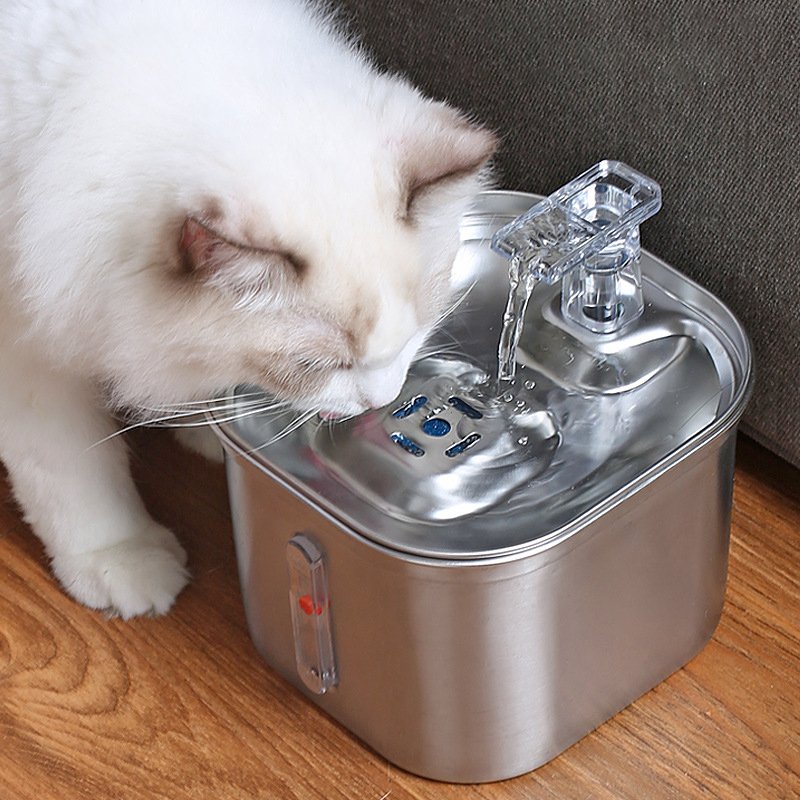
Why a fountain instead of a bowl
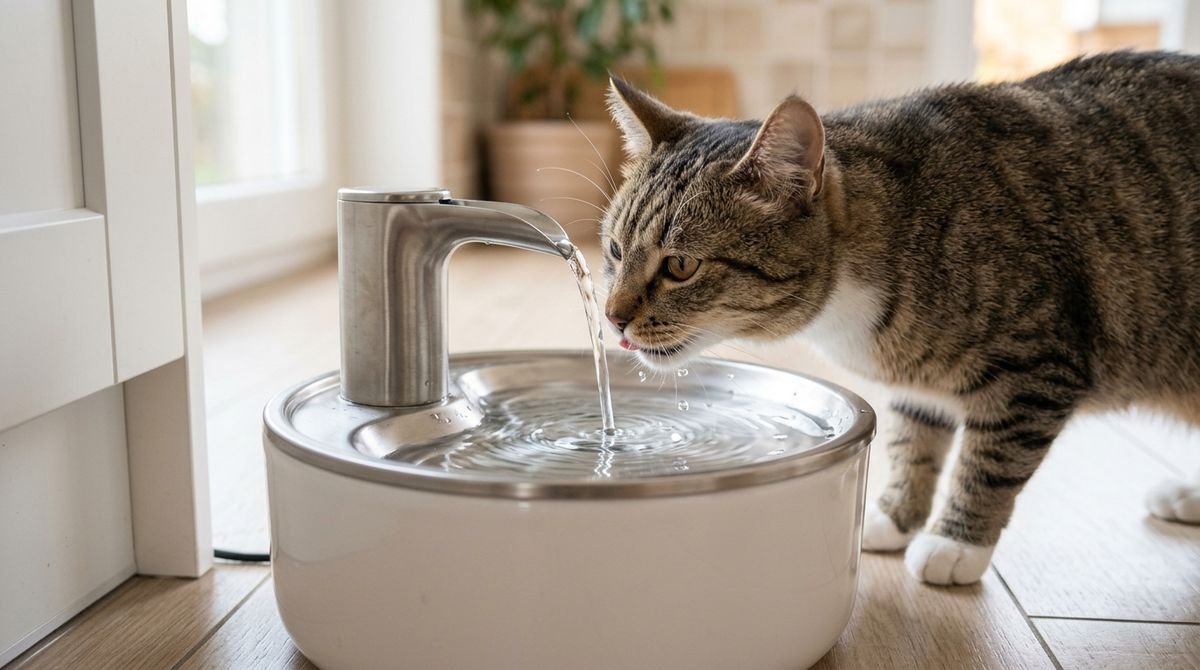
Cats evolved to be cautious about still water, and many of them prefer water that moves. Veterinary sources generally cite daily water needs of around 3.5 to 4.5 ounces per 5 pounds of body weight, with wet food covering part of that. A fountain appeals to the preference for running water, and the constant circulation keeps the surface from developing the stale film that a bowl collects by afternoon. For households where everyone works away from home, a 2-plus liter reservoir also means water does not run dry mid-day.
None of that removes maintenance. A fountain is a water appliance with a filter cartridge, and the filter only works as long as you clean and replace it on schedule. Most of the bad reviews on these products are not about the pump or the design. They are about skipped maintenance.
How pet water fountains work
Every fountain follows the same loop. A small submersible pump pulls water from the bottom of the reservoir, pushes it up through a filter cartridge (or set of filter layers), and releases it through a spout or flower top back into the drinking basin. Gravity returns it to the reservoir, and the cycle repeats. The pump runs continuously while plugged in, which is why noise ratings and cord placement matter more here than on most pet gadgets.
The filter is the part doing the real work, and it is also the part that differs most between models. Understanding the three common filter layers tells you what you are buying and what you will keep buying.
Filter types explained
Activated carbon filters
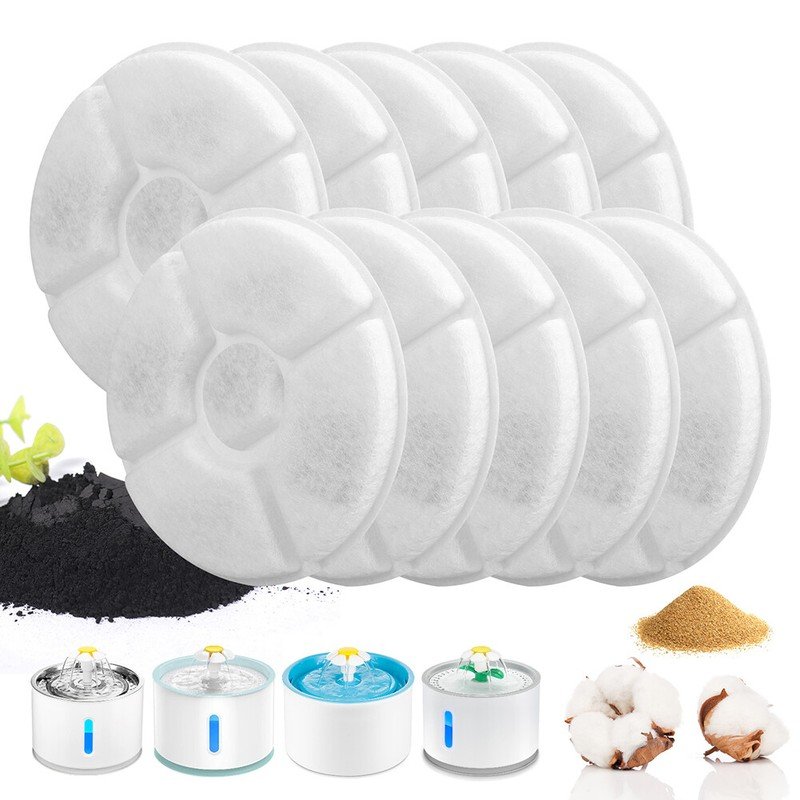
Activated carbon is the black, granular layer in almost every replacement cartridge. Its job is adsorption: dissolved organics, chlorine taste, and odors stick to the carbon’s enormous surface area as water passes through. This is the layer that keeps the water from smelling stale after a few days. Carbon filters saturate, which is why brands generally recommend replacing them every two to four weeks. Once saturated, the carbon does nothing except slow the flow, so this is the cartridge schedule to actually follow.
Foam and mesh pre-filters
Pre-filters sit ahead of the carbon and catch the big stuff: pet hair, food crumbs, and dust. They are usually washable foam or fine mesh, and most brands say to rinse them weekly and replace them every one to two months. Skipping the pre-filter rinse is the fastest way to starve the pump of water, because the clogged layer forces the motor to work harder and run louder.
Ion-exchange resin filters
Ion-exchange resin is the third layer in premium filter stacks, and it is the one that softens water. The resin beads swap calcium and magnesium ions (the minerals behind white scale buildup) for sodium ions. In practice this means less chalky crust on the fountain’s interior and less scale gumming up the pump. Resin exhausts over time and cannot be rinsed back to life, so it rides along with the carbon cartridge’s replacement schedule.
Some filter stacks add a cotton or micro-filter layer as a final polish to catch fine particles. When a product page says “triple filtration” or “quadruple filtration,” this is the stack it is describing: foam, carbon, resin, and sometimes a fine cotton layer. More layers is not automatically better, but the resin layer is the meaningful upgrade if you have hard tap water.
What to check before you buy
Capacity. Match the reservoir to the animal and the household. A single cat needs roughly 7 to 9 ounces of water daily (partly from food), so a 1.3-liter fountain holds about six days of drinking water for one cat, while a 3-liter fountain holds closer to two weeks. But you should not run a fountain two weeks without refilling and cleaning, so treat capacity as a buffer for busy schedules and multi-pet homes, not as permission to ignore the fountain.
Material. Most fountains are BPA-free plastic, which is light and affordable. Stainless steel (usually 304 grade) and ceramic models cost more and weigh more, but their smoother, harder surfaces wipe clean faster and do not scratch the way plastic does. Scratches matter because they give biofilm places to anchor. If you have hard water or tend to clean less often, the upgrade to steel or ceramic pays off in how the fountain looks and smells after six months.
Pump noise and power. Published noise ratings for these pumps usually sit in the low 30s of decibels or below, which is library-quiet. Most fountains are USB-powered with a wall adapter, so plan for an outlet near the drinking spot and a cord route the cat cannot chew. Battery-powered models exist for cord-free placement, but the battery becomes a charging chore of its own. Some designs, like the PETKIT Eversweet line, use a wireless pump that detaches for cleaning and gets power by induction from the base, so there is no cable entering the water at all.
Flow design. Fountains offer free-falling streams, gentle bubbling tops, or both. Timid cats sometimes prefer the quiet bubbling setting; confident drinkers like the stream. A flower-top design with adjustable flow covers both preferences.
Filter cost and availability. The fountain is a subscription. Before buying, check that replacement filters are sold on their own (not only in bundles) and note the two-pack or four-pack price. A fountain whose filters cost a fortune or go out of stock is a fountain you will stop maintaining. This is also where the comparison tables in this article use links instead of prices: filter prices drift, but the current listing is one search away.
Ease of disassembly. You will take this thing apart weekly. Look for a pump that lifts out without tools, a reservoir with a wide mouth you can reach into, and no more than a handful of parts. The best filter in the world does not help if cleaning the fountain is a fifteen-minute puzzle you start dreading.
Three fountains worth comparing
| Petlibro Capsule | Catit Flower Fountain | PETKIT Eversweet 3 | |
|---|---|---|---|
| Capacity | 2.1 L | 3 L | 1.35 L |
| Filter stack | Cotton layer + activated carbon | Cotton mesh + activated carbon + ion-exchange resin | Filter sponge + coconut-shell activated carbon + ion-exchange resin |
| Material | BPA-free plastic; stainless-steel-top version available | BPA-free plastic | BPA-free plastic; wireless pump |
| Flow options | 360-degree drinking area, faucet-like stream | Flower top with 3 flow settings | Adjustable flow with app smart mode |
| Best for | Single- or two-cat homes, 360 access | Multi-cat homes, hard tap water | Tech-friendly owners, easy pump cleaning |
| Price | Check price on Amazon | Check price on Amazon | Check price on Amazon |
Figures as published by the brands and major retailers.
Petlibro Capsule: the everyday pick
The Petlibro Capsule holds 2.1 liters and pairs a cotton filter layer with an activated-carbon cartridge, covering the two layers that matter most. The 360-degree design lets cats drink from any side, and the translucent tank with a water-level window makes it obvious when a refill is due. The lineup includes a version with a 304 stainless steel top plate, which is the one to pick if you want the easier-cleaning surface. Good fit for one- or two-cat households that want a simple, widely reviewed fountain with readily available replacement filters.
Catit Flower Fountain: the hard-water pick
The Catit Flower Fountain’s 3-liter tank is the largest of the three, and its triple-action filter (cotton mesh, activated carbon, ion-exchange resin) is the only one here with a softening layer as standard. That resin layer is the reason to choose it if your tap water leaves white scale on kettles and fixtures: less mineral buildup on the fountain walls and on the pump. The flower top offers three flow settings, including a quiet bubbling mode for timid drinkers. Good fit for multi-cat homes and hard-water households. Skip if you want app features or a steel build; this is a straightforward plastic fountain done well.
PETKIT Eversweet 3: the easy-to-clean pick
The Eversweet 3 trades capacity (1.35 liters) for maintenance convenience. Its pump is wireless: the pump unit sits in the water and draws power by induction from the base, so there is no cable in the reservoir and the whole pump lifts out for cleaning in seconds. The purification system runs a filter sponge plus coconut-shell activated carbon plus ion-exchange resin, and the PETKIT app adds a smart mode that runs the pump on a schedule instead of continuously. Good fit for owners who will actually keep the app habit and want the fastest weekly cleaning of the three. Skip if you have multiple cats or travel often; the smaller tank needs refilling every few days.
A cleaning routine that keeps the filter working
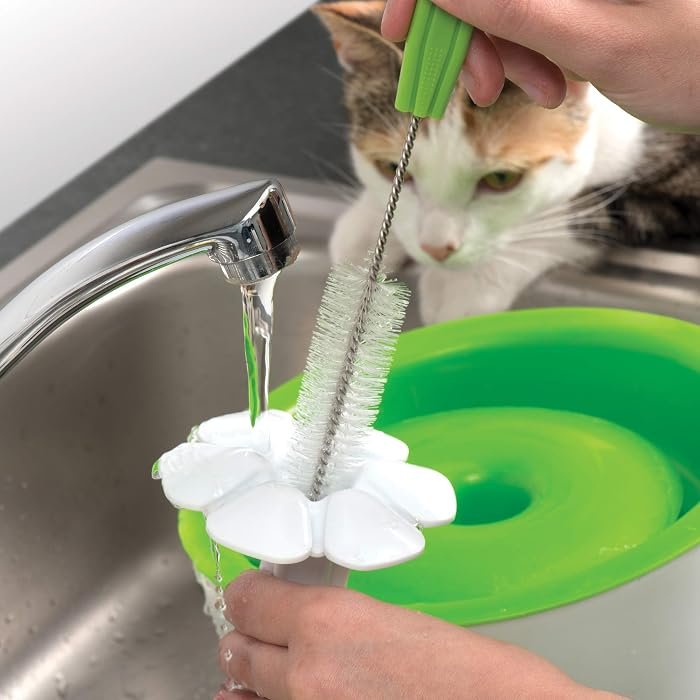
Weekly (ten minutes). Empty the fountain completely. Rinse the reservoir and drinking basin with warm water. Pull out the pump, remove its cover, and rinse the impeller and intake under running water, picking out any hair wrapped around the rotor. Rinse the foam pre-filter. Refill with fresh water and drop in the filter cartridge. This is the routine that prevents 90 percent of fountain problems: noise, weak flow, and slime.
Monthly (twenty minutes). Do the weekly routine, then deep clean. Soak the reservoir, basin, and pump parts in a one-to-one mix of white vinegar and warm water for about thirty minutes to dissolve mineral scale, then scrub with a bottle brush or an old toothbrush and rinse thoroughly until the vinegar smell is gone. Check whether your model has dishwasher-safe parts; many plastic reservoirs are top-rack safe, but the pump and filter cartridge never go in the dishwasher.
Filter replacement. Replace the carbon cartridge every two to four weeks per the brand’s guidance, and the foam pre-filter every one to two months or when rinsing no longer restores the flow. If the flow looks weak right after a fresh cartridge and a clean pump, the issue is usually scale inside the pump housing or a kinked intake, not the filter. If the fountain develops a musty smell even with a new cartridge, soak everything in the vinegar mix and check the silicone seals, which can trap residue.
One habit that saves filters: top off the water every day or two instead of letting the level drop. Pumps last longer and run quieter when fully submerged, and a low water line concentrates minerals and speeds up cartridge exhaustion.
FAQ
Do I need the brand’s own replacement filters?
For the carbon cartridge, mostly yes. Cartridges are shaped to fit specific fountain models, and a loose-fitting cartridge lets unfiltered water bypass the media. Foam pre-filters are more forgiving and can sometimes be cut from generic filter foam, but the carbon cartridge should match the model.
Can I use tap water in a pet fountain?
Yes, if your tap water is safe for people it is safe for the fountain. In hard-water areas the resin layer in triple-action filters helps with scale, and the monthly vinegar soak handles the rest. If your water is heavily chlorinated, letting it sit uncovered for an hour before filling helps the chlorine dissipate, and the carbon filter handles the rest.
Why is my fountain suddenly loud?
Almost always one of three things: the water level dropped below the pump intake, hair is wrapped around the impeller, or the pre-filter is clogged. Refill, clean the pump, rinse the foam, and the noise usually disappears. A pump that stays loud after cleaning may be at the end of its life; replacement pumps are sold separately for most popular models.
Are fountains safe to leave running all day?
These pumps are designed for continuous operation and draw only a few watts, so leaving one running is normal. The risk is not the pump; it is the water running low. Keep the reservoir filled above the minimum line, and if you travel for more than a couple of days, a large-capacity fountain plus a reliable automatic feeder still needs a human checking in. Fountains are not a substitute for a pet sitter.
Plastic, steel, or ceramic?
All three work. Plastic is light and cheap but scratches over time, which gives biofilm texture to grip. Stainless steel and ceramic wipe clean faster and resist odors better, at a higher price and weight. If you are choosing between two otherwise identical fountains, the steel or ceramic one will look and smell better at the one-year mark with the same cleaning routine.
Still building your pet-tech setup? Our pet GPS tracker buying guide covers how to keep tabs on outdoor cats, and the automatic pet feeder guide walks through portion control if your cat’s meals need scheduling too.
1 thought on “Pet Water Fountains: Filter Types, Materials, and How to Clean Them”