
As an Amazon Associate, Fetchvera earns from qualifying purchases. We research published specs — we don’t accept free products or paid placements.
An automatic feeder is really three products in one: a food hopper, a portioning mechanism, and (on smart models) an app. Get any of the three wrong and you’ll be hand-feeding anyway. Here’s what the spec sheet tells you — and what it doesn’t.
Capacity: match the hopper to your pet
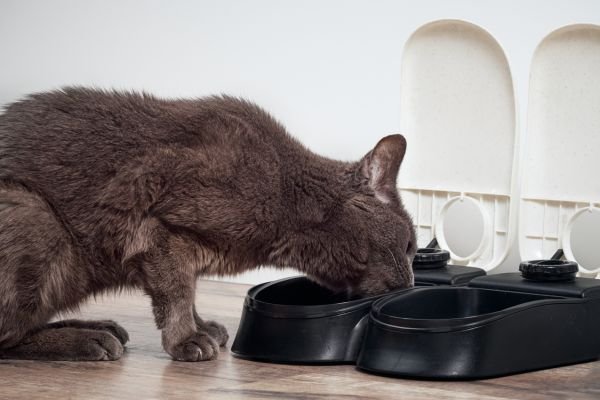
Hopper capacity is measured in liters, and it translates directly to how often you refill. PETLIBRO’s Granary line comes in 3L (about 12.6 cups) and 5L (about 21 cups) hoppers; the company estimates a full 5L hopper lasts roughly 30 days for a typical 5 kg adult cat eating around 80 g of dry food per day. That’s a useful anchor: for one cat, 5L means refilling monthly; for two cats or a small dog, halve it.
Bigger isn’t automatically better. Kibble goes stale, and a hopper that sits half-full for six weeks needs the freshness features below to earn its size.
Portion control: the spec that decides everything
This is the single most important number on the sheet. PETLIBRO’s Granary dispenses 1–50 portions per meal at roughly 20 ml (about 10 g, or 1/12 cup) each, across up to 10 scheduled meals per day. Do the math for your pet: a cat needing 1/2 cup daily needs 6 portions, split however you like across the day.
Watch for two gotchas. First, minimum portion size — a feeder whose smallest dispense is 1/4 cup can’t serve a pet on a restricted diet. Second, kibble compatibility: PETLIBRO specifies 2–15 mm kibble, and warns that oversized or irregularly shaped pieces (cubes, crescents) jam the mechanism. Measure your kibble before you buy the feeder, not after.
Freshness: lids, seals, and desiccant
Dry food stales through air and moisture, so look at the hopper like a storage container. PETLIBRO’s Granary uses a twist-lock lid, a sealing strip, and a desiccant bag (two bags used together on the newer 2 Series, replaced every 14 days) plus a patented rotor that blocks pets from prying extra food out. An infrared sensor watches for jams and stops dispensing if the outlet blocks. These aren’t luxury features — they’re what keeps a month of kibble edible and your pet out of the hopper.
Power: plan for the outage
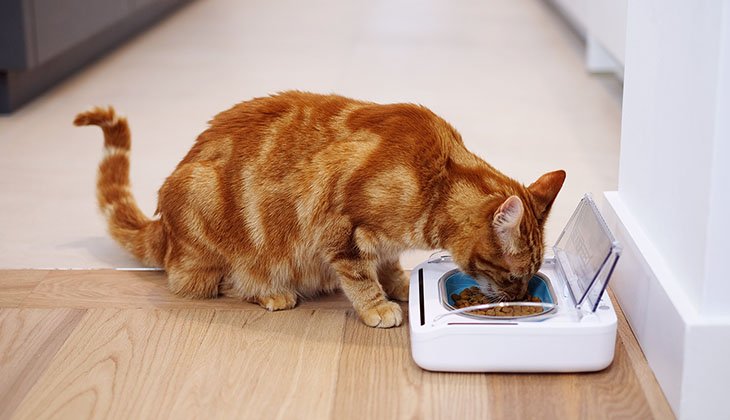
Feeders need a power-failure plan, because a missed meal is the whole failure mode. The Granary runs on a USB-C adapter with battery backup — 3 D-cell alkalines on some models, a built-in rechargeable backup (rated ~24h) on the newer 2 Series. Check two things: does the backup actually dispense on schedule during an outage (not just keep the clock alive), and how will you know the power failed? App notifications for jams, low food, and low battery are worth more than a second camera.
Smart features: app control vs. scheduled simplicity
Wi-Fi models (PETLIBRO supports both 2.4 GHz and 5 GHz) let you adjust schedules and portions from your phone, check feeding logs, and get low-food alerts. The Granary 2 Series even adds a scale (up to 7.5 kg) for gram-level intake tracking. Non-Wi-Fi models use onboard buttons and an LCD — simpler, cheaper, and immune to router problems.
Be honest about which you’ll maintain. An app-controlled feeder whose app you never open is just an expensive button feeder. And a button feeder is perfectly fine if your schedule is consistent.
Wet food and special cases
Nearly all hopper feeders — Granary included — are dry-kibble-only. If your pet eats wet food, you need a refrigerated or rotating-tray feeder, which is a different product category with much shorter freshness windows (typically 1–3 days). Don’t try to force wet food through a dry feeder; you’ll get a jam and a mess.
Multi-pet homes should also check whether portions split or duplicate: on dual-bowl setups, confirm whether each bowl gets the programmed portion or half of it.
What we’d look for, by use case
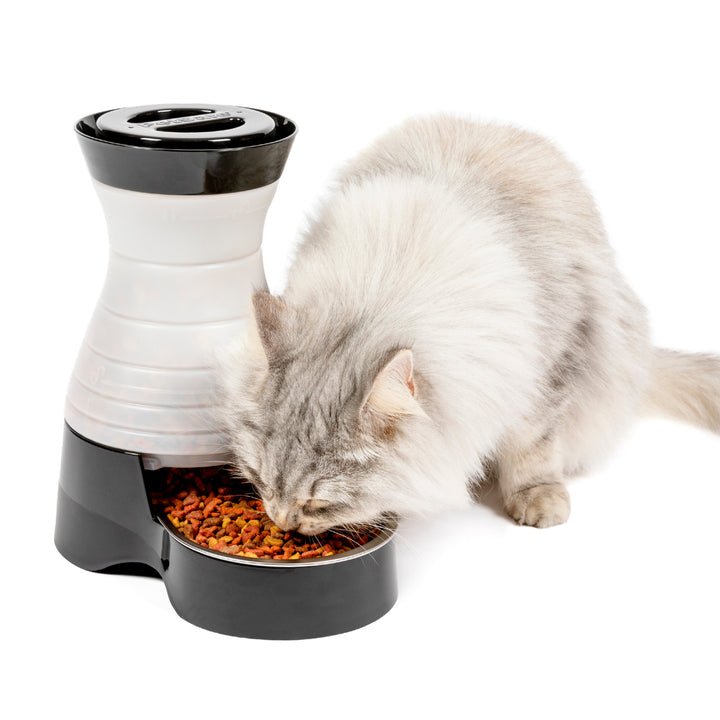
For weight management: Prioritize small minimum portions and many meals per day. Six small meals beats two big ones for a dieting cat, and only a feeder with fine portion control can do it while you’re at work.
For weekend trips: Maximize hopper capacity and verify the power backup actually dispenses — not just the clock. A feeder that needs you home every 48 hours isn’t a travel feeder.
For grazers vs. gobblers: A gobbler needs strict scheduled portions; a grazer does fine with a larger hopper and fewer meals. Match the mechanism to the eating style, not the other way around.
The bottom line
Size the hopper to your refill tolerance, confirm the portion math works for your pet’s diet, check kibble compatibility, and make sure the power backup covers real outages. Everything else — voice recordings, cameras, feeding logs — is a tiebreaker, not a foundation.
Match a feeder to your pet’s routine with our Pet Tech Finder, or read the companion guides: choosing a GPS tracker and pet camera features worth paying for.