
As an Amazon Associate, Fetchvera earns from qualifying purchases made through links on this page, at no extra cost to you.
Trimming a pet’s nails at home comes down to one choice before anything else: a grinder or a pair of clippers. Both tools do the same job, but they remove nail in different ways, and that difference decides which one feels easier in your hands and calmer for your pet. A grinder files the nail down a little at a time. Clippers cut a small piece off in one motion. Neither approach is right for every pet, and the best choice often depends on nail thickness, coat length, and how patient your pet is about having its paws handled.
This guide explains how each tool works, what motor speed and grit ratings mean on a grinder, how clipper guards work, and which tool fits common situations. It also covers the small details that cause most trouble, like heat buildup from grinding and cutting too close with clippers.

How a nail grinder works
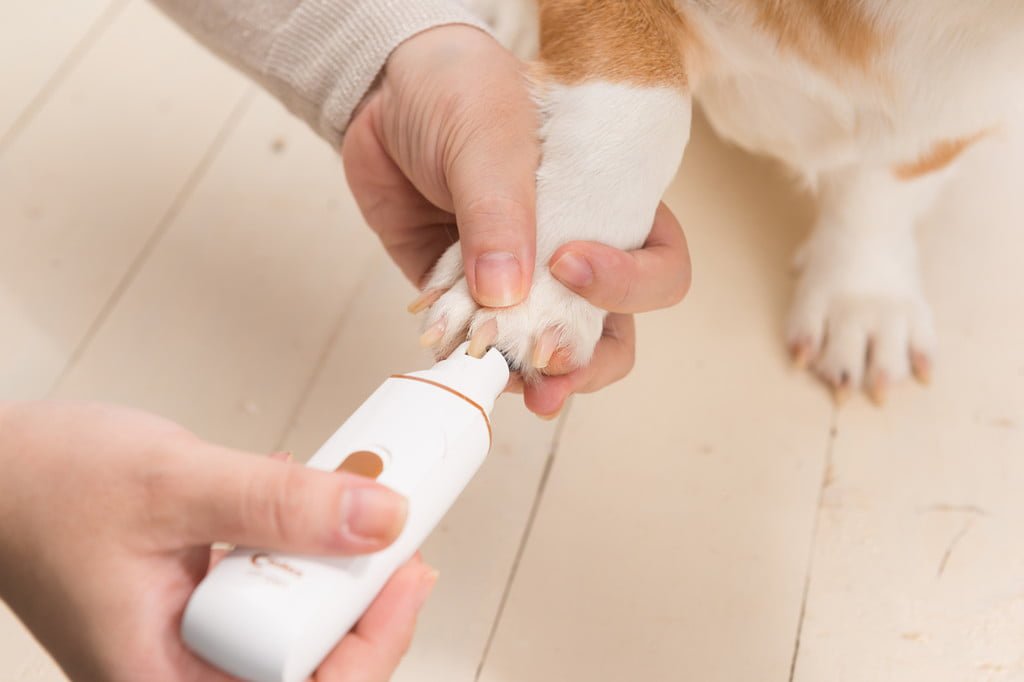
A nail grinder is a small rotary tool with a spinning abrasive tip. You hold the tip against the nail and it sands the nail down, a thin layer at a time. Most pet grinders are cordless and rechargeable, and they come with a set of sanding bands, grinding stones, or discs that fit onto the tip. Coarser grit removes material faster; finer grit leaves a smoother finish.
The advantage of grinding is control. Because each pass removes so little, you can stop, look at the nail, and decide whether another pass is needed. That makes it easier to shape the nail and round off sharp edges instead of leaving a flat cut edge. The trade-off is time. Grinding all four paws takes longer than clipping, and the tool makes noise and vibration that some pets dislike at first.
Heat is the main thing to watch. Friction from the spinning tip warms the nail, and holding the grinder in one spot too long makes the nail uncomfortably warm. Short passes of a few seconds, with breaks between them, keep the nail cool and keep the session calm.
How nail clippers work
Clippers cut the nail in a single squeeze. There are two common designs. Guillotine clippers have a hole that the nail slides into, and a blade slides across the hole to cut it. Scissor clippers work like a pair of scissors, with two curved blades that close around the nail. Scissor designs are usually the better match for thick nails, while guillotine designs suit small and medium nails.
Many clippers include a safety guard, a small metal plate that sits behind the blade and limits how much nail can enter the cutting area. The guard is a useful backstop against cutting too much at once, but it is not a guarantee. It limits the length of each cut, not the position of the cut, so you still need to judge where to cut on each nail.
The advantage of clippers is speed. One confident squeeze per nail, and a full set of paws can be done in minutes. The trade-off is that each cut is final. If you cut more than planned, you cannot put it back, and the cut edge can feel sharp until it is filed smooth.

Motor speed and grit: what the numbers mean
Grinder speed is usually listed in revolutions per minute (RPM). A wider speed range gives you more room to match the tool to the nail. Low speeds are gentler and quieter, which suits small nails and nervous pets. High speeds remove material faster, which suits thick nails, but they also build heat faster and make more noise.
Published specs make the range concrete. The Dremel PawControl 7760-PET is a cordless, rechargeable grinder with a 4-volt lithium-ion battery and a listed speed range of 8,000 to 25,000 RPM across four speed settings. Its kit includes a nail guard with a 45-degree paw guide, which is designed to hold the nail at a steady angle and keep fur away from the spinning tip. Dremel lists a two-year warranty for the tool.
What that range means in practice is simple. Start at the lowest speed and move up only if the nail is thick and the pet is settled. A low speed that takes a few extra passes is a better result than a high speed that heats the nail or startles the pet. If your grinder has only two speeds, the same rule applies: low for small or thin nails, high for thick nails, with short passes either way.
Grit works the same way. A coarse sanding band shapes a thick nail quickly but leaves a rough edge. A fine band or grinding stone finishes the edge smoothly. Many kits include both, and switching from coarse to fine for the last pass gives a smooth result without spending the whole session on a fine grit.
Safety guards and cutting too close
Every nail has a quick, the living tissue inside the nail that contains blood vessels and nerves. Cutting or grinding into it hurts and bleeds. On light-colored nails you can often see the quick as a pink area inside the nail, which makes judging the cut easier. On dark nails you cannot see it, so the safe method is to remove a little at a time and check the cut surface after each pass. A gray or pink center appearing in the cut surface means you are close and should stop.
Clipper guards help by limiting how much nail fits into the blade at once, but they do not judge the quick for you. The safest habit with clippers is to cut small pieces, check, and cut again, rather than taking a large piece in one squeeze. With a grinder, the equivalent habit is short passes with pauses to check and let the nail cool.
Keep styptic powder or a styptic pencil nearby before you start. It stops minor bleeding quickly if you do nick the quick. If a nail bleeds heavily or your pet is in obvious distress, stop the session and contact your veterinarian or groomer for advice.
Which tool fits which pet
Thick, hard nails favor a grinder or a sturdy pair of scissor clippers. A small guillotine clipper can struggle with a thick nail, and forcing it can crush the nail instead of cutting it cleanly. If you use clippers on thick nails, choose a scissor design with handles that give you leverage, and replace the blades when they dull. A dull blade crushes; a sharp blade cuts.
Nervous pets often do better with whichever tool they have been introduced to gradually. A grinder’s noise and vibration can bother a noise-sensitive pet, while the pressure of a clipper squeeze can bother a pet that dislikes restraint. Neither reaction is a verdict on the tool. A few short, treat-paired introductions with the tool off, then on but not touching the nail, usually tell you which one your pet tolerates better.
Long fur around the paws favors a grinder with a guard, because the guard keeps fur away from the spinning tip. With clippers, long fur matters less, since there is no spinning part to catch it. For cats and small animals, a smaller tool in either style is easier to control, and small nails need only light passes or small cuts.
Owners with limited hand strength sometimes prefer a grinder, because it needs a steady hold rather than a strong squeeze. Owners who want the job done fast, and whose pets sit still for it, often prefer clippers. Both preferences are reasonable, and many owners keep both tools: clippers for a quick trim, and a grinder to smooth the edges afterward.
Grinder vs clipper at a glance
| Feature | Nail grinder | Nail clippers |
|---|---|---|
| How it removes nail | Sands a thin layer at a time | Cuts a piece off in one squeeze |
| Control over length | High, with gradual shaping | Moderate, each cut is final |
| Speed for a full set of paws | Slower | Faster |
| Noise and vibration | Present, varies by speed | None |
| Heat risk | Yes, if held in one spot | No |
| Edge finish | Smooth, rounded | May need filing to smooth |
| Best for thick nails | Yes, at higher speeds | Yes, with scissor-style clippers |
For a first purchase, a rechargeable grinder with multiple speeds is a flexible starting point if you have the patience for gradual sessions. The Dremel PawControl pet nail grinder is one example with published specs to compare against, and other rechargeable handheld grinders follow the same pattern of speed settings and interchangeable tips. If speed matters more to you, a sharp pair of scissor or guillotine clippers with a safety guard is the simpler buy, and you can check current options by searching for guillotine dog nail clippers with a safety guard or a scissor-style equivalent that matches your pet’s nail size.
How to switch tools without stressing your pet
If your pet is used to one tool and you want to try the other, do not switch mid-session. Introduce the new tool over a few days, in sessions that end before the pet gets restless. Let the pet sniff the tool while it is off, run it nearby without touching a nail, and reward calm behavior. When you do trim with the new tool, do one or two nails and stop. A short, calm first session beats a complete session that ends in a struggle, and it makes the next session easier.
The same gradual approach works for pets that have never had their nails trimmed at home. Handle the paws during calm moments, reward the pet for letting you touch each toe, and keep early sessions to a few nails. Regular, short sessions keep nails manageable, which means each session is easier than a rare, long one.

Maintenance that keeps either tool working
Grinder tips wear out. A sanding band that has gone smooth removes little and builds heat faster, so replace bands when they stop cutting well, and check grinding stones for wear. Keep the tool charged before a session, since a low battery can slow the motor and make grinding drag.
Clipper blades dull with use. If a cut starts to crush or split the nail instead of slicing it, the blade is dull and the tool should be replaced or, where the design allows, the blade changed. Wipe the blades clean after each session and store the tool dry, since moisture dulls edges and stiffens the hinge.
Whichever tool you choose, the routine matters more than the brand. Short, regular sessions, small removals, and a check after each pass keep nails in shape without drama. If your pet consistently resists home trimming, or if a nail looks damaged, cracked, or infected, a professional groomer or veterinarian is the right next step rather than pushing through at home.
A nail tool is one part of a wider home setup. A regular grooming routine pairs well with the rest of your pet’s daily care, from keeping a water fountain clean to choosing a pet door that suits your home. The tool you pick matters less than using it regularly, in short sessions, with a clear view of each nail.
1 thought on “Pet Nail Grinders vs Clippers: Motor Speed, Guards, and How to Choose”