
As an Amazon Associate, Fetchvera earns from qualifying purchases made through links on this page, at no extra cost to you.
If your dog hesitates at the side of the bed or stands at the back of the car looking up at the cargo area, you have probably wondered whether stairs or a ramp would help. Both solve the same problem, which is a height gap that is too big for a comfortable step or jump. They solve it in different ways, and the right choice depends on the height you need to bridge, how much floor or driveway space you have, and how your pet actually moves.
Stairs break a climb into short steps. Ramps replace the climb with one continuous slope. A pet that walks steadily up a gentle slope may still balk at steps, and a pet that happily climbs steps may refuse a ramp that feels too steep or too narrow. This guide explains how each type works, what the published specs mean, and how to measure your own bed, sofa, or vehicle before you buy. It finishes with a short checklist you can run through at home with a tape measure.
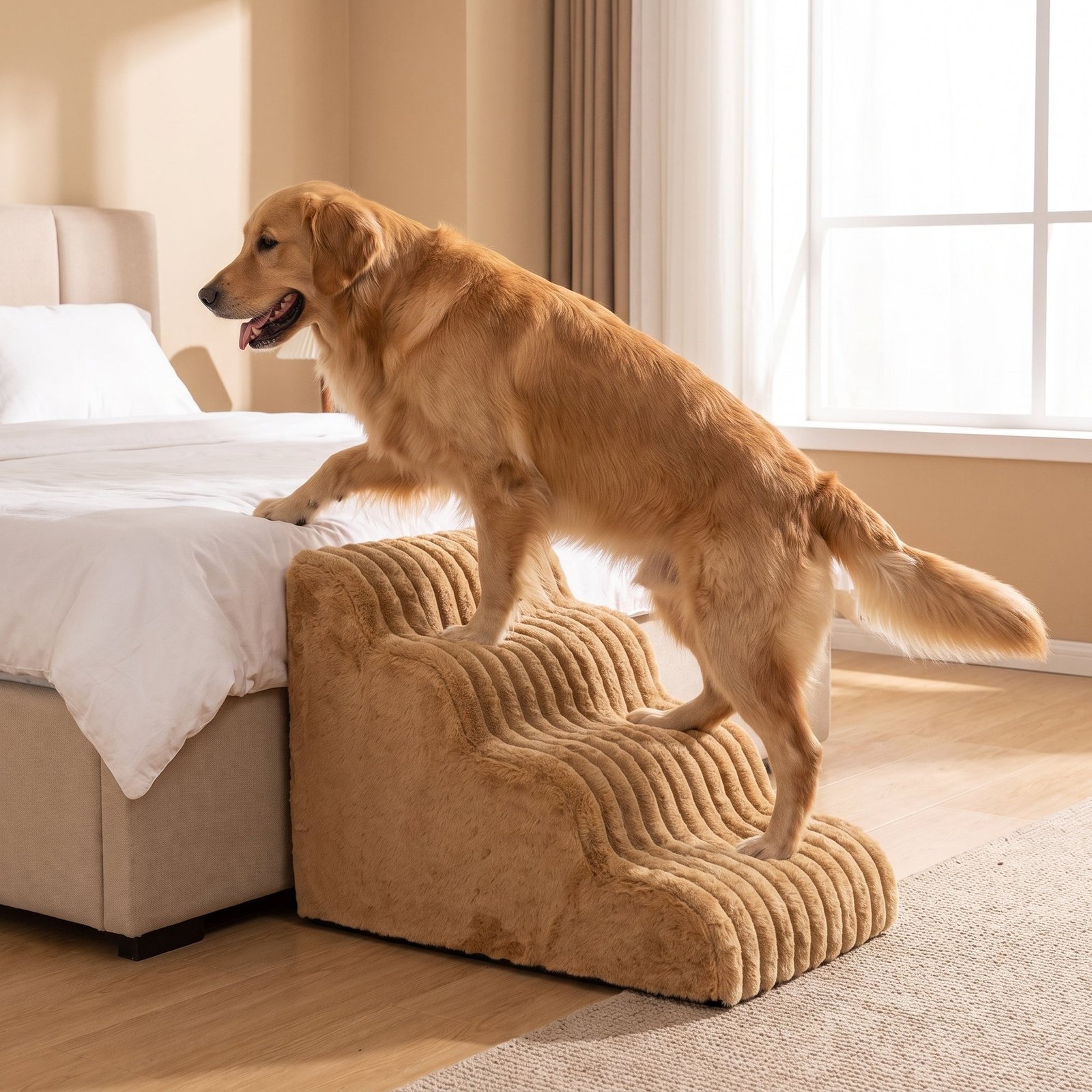
Stairs or a ramp: the core difference
The core difference is how the climb is divided. Stairs ask a pet to lift each paw onto a raised platform, shift its weight, and repeat. That works well for pets that are confident stepping up and down, and it works well indoors, where the total height is usually 16 to 25 inches and the stairs can stay in one place beside the bed or sofa.
A ramp asks a pet to walk up a slope without lifting its paws as high. That suits pets that move slowly, pets with short legs relative to the height they need to reach, and pets that are unsure on steps. The trade-off is length. A gentle slope needs a long ramp, and a long ramp needs floor space at home or driveway space at the car. A short, steep ramp is often the reason a pet refuses to use it at all.
Neither option is better in every home. The question to answer first is not which product looks nicer. It is how high the gap is, how far the pet can comfortably step up in one motion, and how much room you have for the aid itself.
Start by measuring the gap
Measure from the floor to the top surface your pet needs to reach, not to the edge of the mattress or the bumper. For a bed, measure to the top of the mattress where the pet will step off. For a sofa, measure to the seat cushion. For a car, measure to the cargo floor or the seat your pet will step onto. Write that number down, because it decides the step count on stairs and the length needed on a ramp.
Next, look at the step height your pet already handles without hesitation. Most household steps are about 7 inches high, and many pets handle that easily. If your pet already climbs the stairs in your house without pausing, a pet stair set with a similar rise per step is a reasonable starting point. If your pet pauses on household stairs or needs to be lifted over a single high step, a ramp with a gentle slope is the safer bet.
Also measure the space where the aid will sit. A bedside stair set needs a footprint roughly as wide as the stairs and as deep as the stair run. A bed ramp needs a much longer run along the side of the bed, and many bedrooms do not have that much clear floor. A car ramp needs a clear strip behind the vehicle long enough for the full ramp length plus room for the pet to approach it in a straight line.
How pet stairs are sized
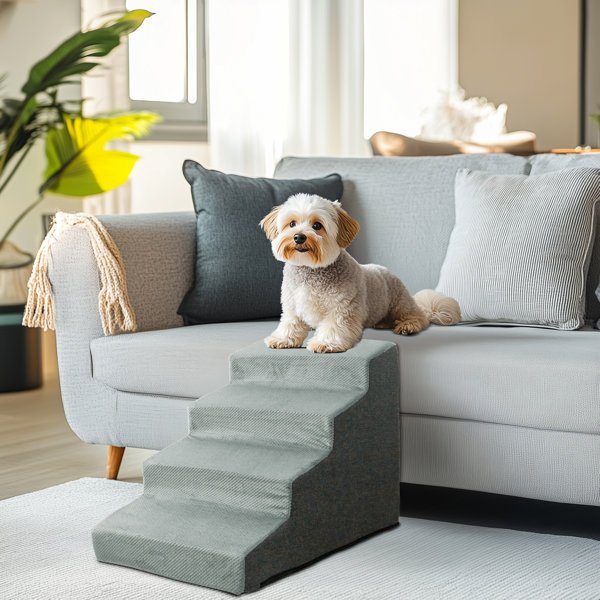
Pet stairs are described by three numbers: the number of steps, the height of the top step, and the weight rating. The top step should sit close to the surface your pet is climbing to, ideally within a couple of inches, so the final step onto the bed or sofa is a small one rather than a jump. A top step that sits far below the mattress leaves the hardest step for last, which defeats the purpose.
Step depth matters as much as step height. A deep step gives a pet room to place its whole paw and shift its weight before the next step. Shallow steps force a pet to hurry or to place its paws sideways, which is awkward for larger dogs and for cats that like to pause mid-climb. When a listing gives the overall depth of the stair set, divide it by the number of steps to get a rough idea of each tread, and compare that with the length of your pet’s paw plus a little margin.
Weight ratings are the manufacturer’s tested limit, and they vary a lot between models. The Pet Gear Easy Step II, for example, is a two-step stair set measuring 22 inches deep by 16 inches wide by 16 inches high, with a published weight recommendation of up to 150 pounds and removable, washable carpet treads. That 16 inch top height suits a low sofa or a low bed, not a tall bed, and the two-step design means each step is doing more work than a three or four step set of the same height. Check price on Amazon.
How pet ramps are sized
Ramps are described by length, width, weight rating, and whether they fold or telescope. Length decides the slope. For the same height, a longer ramp gives a gentler slope, and a gentler slope is easier for a pet to walk up and down. As a rough guide, a ramp that is about twice as long as the height it bridges gives a slope most pets will accept, while a ramp that is only as long as the height is a steep climb that many pets will refuse.
Width decides confidence. A ramp that is barely wider than the pet’s body leaves no margin if the pet drifts sideways, and a pet that steps off the edge once may refuse the ramp afterwards. Side rails or raised edges help, especially on car ramps, because they give a visual boundary and a physical stop. The walking surface matters too: carpet, high traction coating, and ribbed rubber all grip better than smooth plastic or bare metal, and grip matters most on the way down, when a pet’s weight is pushing forward.
Bed ramps and car ramps are built for different jobs, and their specs show it. The PetSafe CozyUp Bed Ramp is a wooden bedside ramp measuring 70 inches long by 16 inches wide by 25 inches high, with a published weight rating of up to 120 pounds and a heavy duty carpet surface. Its length is what makes the slope gentle enough for a bedroom, and its fixed size is why it needs a long clear run beside the bed. It does not fold away, so the space it takes is the space it always takes. Check price on Amazon.
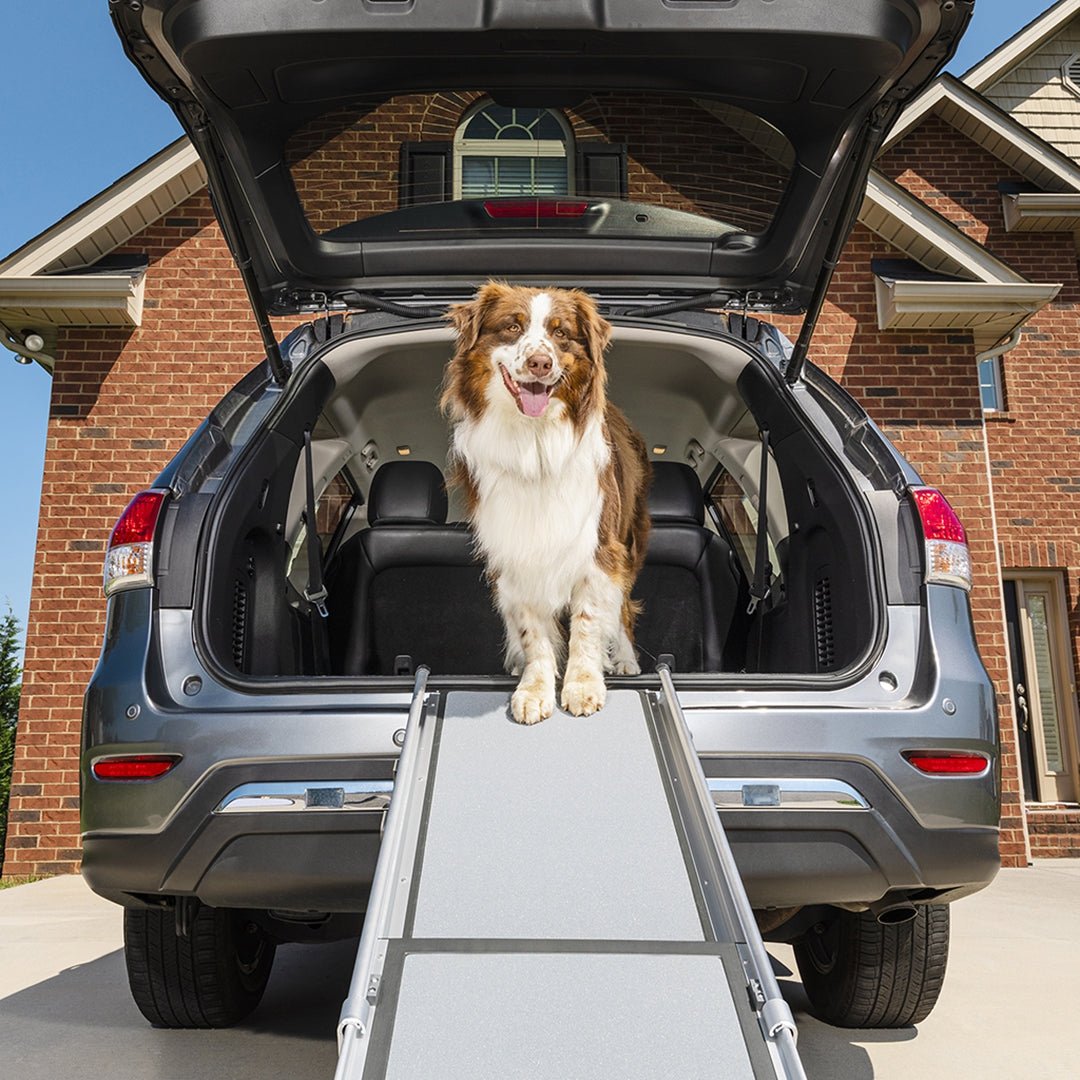
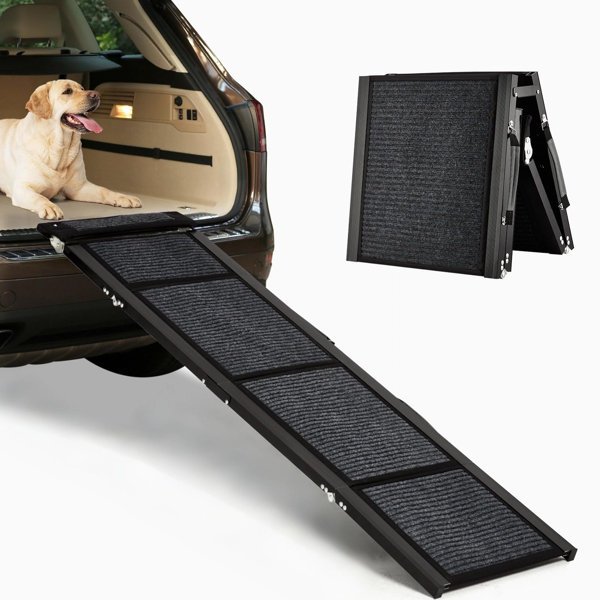
Car ramps, by contrast, have to travel. The PetSafe Happy Ride telescoping ramp line is built from aluminum, and the compact version extends from 28 to 70 inches and is rated to support pets up to 300 pounds, according to the manufacturer’s published specs. Telescoping matters here because the same ramp can be set shorter for a low car and longer for a tall SUV, which keeps the slope reasonable in both cases, and it collapses down for storage in the cargo area. Check price on Amazon.
Stairs vs ramps at the bed and sofa
At the bed, the deciding factor is usually floor space. If you have a long clear run beside the bed, a bed ramp gives the gentlest climb and suits a pet that moves slowly or pauses on steps. If your bedroom is tight, stairs fit into a much smaller footprint, and a three or four step set can reach a standard bed height without taking over the room. Measure the run available beside the bed before you fall in love with either option, because a ramp that cannot extend fully is a ramp that will sit at a steep angle.
At the sofa, stairs usually win on practicality. Sofa seat heights are lower than bed heights, so a two or three step set is often enough, and the stairs can sit at the end of the sofa where they do not block a walkway. A ramp at sofa height is short, which means it is either steep or it sticks out a long way into the room for a small gain. The exception is a pet that genuinely cannot manage steps at all, in which case a short ramp with a good grip surface is still better than repeated jumping.
Stairs vs ramps at the car
At the car, ramps usually win, and the reason is height plus space. Cargo floors on SUVs and trucks sit high, and the ground behind the car gives you room for a long ramp that a bedroom often does not. A folding or telescoping ramp also solves the storage problem, since it collapses into the cargo area or the garage between trips. Pet stairs for cars exist, but they are heavy to carry, they need to be set up at the right height for each vehicle, and a tall vehicle can need a four or five step set that is awkward to load and unload.
Car ramps have their own checklist. The ramp must reach the cargo floor without a gap at the top, because a pet that has to jump the last few inches will hesitate at the top of the slope. The feet at the bottom must grip the ground, especially on wet pavement or gravel. And the ramp must be rated well above your pet’s weight, not just equal to it, because a pet moving down a ramp puts more force on the surface than a pet standing still. A rating of 150 pounds for a 140 pound dog leaves almost no margin; a rating of 300 pounds for the same dog leaves plenty.
Weight limits, foldability, and cleaning
Weight limits deserve a careful read, because listings sometimes mix up two different numbers: the weight of the product itself and the weight it can support. Look for the phrase the manufacturer uses, such as “supports pets up to” or “maximum weight recommendation”, and use that number, not the product’s shipping weight. If a listing gives two different limits in different places, use the lower one, and check the manufacturer’s own page when you can.
Foldability decides where the aid lives when it is not in use. Folding stairs and folding ramps collapse flat or into a smaller shape, which suits a car, a small apartment, or a room where the aid is only needed at night. Fixed wooden ramps and large foam stairs do not fold, so they need a permanent home. Telescoping ramps are a middle option: they slide shorter for storage but stay rigid in use, which suits vehicles of different heights.
Cleaning is the detail people forget until the first muddy paw prints appear. Carpet treads can be vacuumed and, on some models, removed and washed, but they hold hair and they take time to dry. Smooth surfaces wipe clean in seconds but can be slippery when wet, so look for a textured or ribbed finish rather than a glossy one. Foam stairs with removable covers are the easiest to keep fresh, provided the cover actually comes off without a fight, so check that detail in the listing before you buy.
Comparison: three published examples
The table below compares three real products using only their published specs.
| Product | Published size | Published weight rating | Best for | Price |
|---|---|---|---|---|
| Pet Gear Easy Step II pet stairs | 22 inches deep by 16 inches wide by 16 inches high, 2 steps | Up to 150 pounds | Low sofas and low beds indoors | Check price on Amazon |
| PetSafe CozyUp Bed Ramp | 70 inches long by 16 inches wide by 25 inches high | Up to 120 pounds | Bedrooms with a long clear run beside the bed | Check price on Amazon |
| PetSafe Happy Ride compact telescoping ramp | Extends from 28 to 70 inches | Up to 300 pounds | Cars, SUVs, and trucks of different heights | Check price on Amazon |
How to choose in five steps
First, measure the height to the bed, sofa, or cargo floor, and measure the floor or driveway space available for the aid. Second, decide whether your pet steps up confidently or moves better on a slope, using the household stairs test described above. Third, shortlist only models whose top step or ramp top reaches within a couple of inches of the target surface, and whose weight rating clears your pet’s weight with margin. Fourth, check the practical details: non-slip feet, a grip surface that suits wet paws, a weight you can carry, and a cleaning method you will actually use. Fifth, introduce the aid slowly, with the pet walking up and down for a treat at each step or partway up the ramp, before you expect it to be used at night or at a busy car park.
If you are still torn between stairs and a ramp for the bed, let the room decide. A long clear run points to a ramp, a tight bedroom points to stairs, and a pet that refuses one type after a fair introduction period is telling you something useful. The best aid is the one your pet will actually use every day, not the one with the longest spec sheet.
For more on choosing pet gear by published specs rather than marketing claims, see our guides to pet nail grinders vs clippers and pet water fountain filter types and cleaning. If you are still deciding between two similar models, measure twice, check the weight rating against your pet’s actual weight, and pick the option that fits the room you have, not the room you wish you had.